
The Orisecra Digital Trust Engine
Continuous Trust. Not Automatic Trust
Traditional security often asks one question:
Did the user enter the correct password?
Orisecra asks a broader question:
Should this activity be trusted right now?
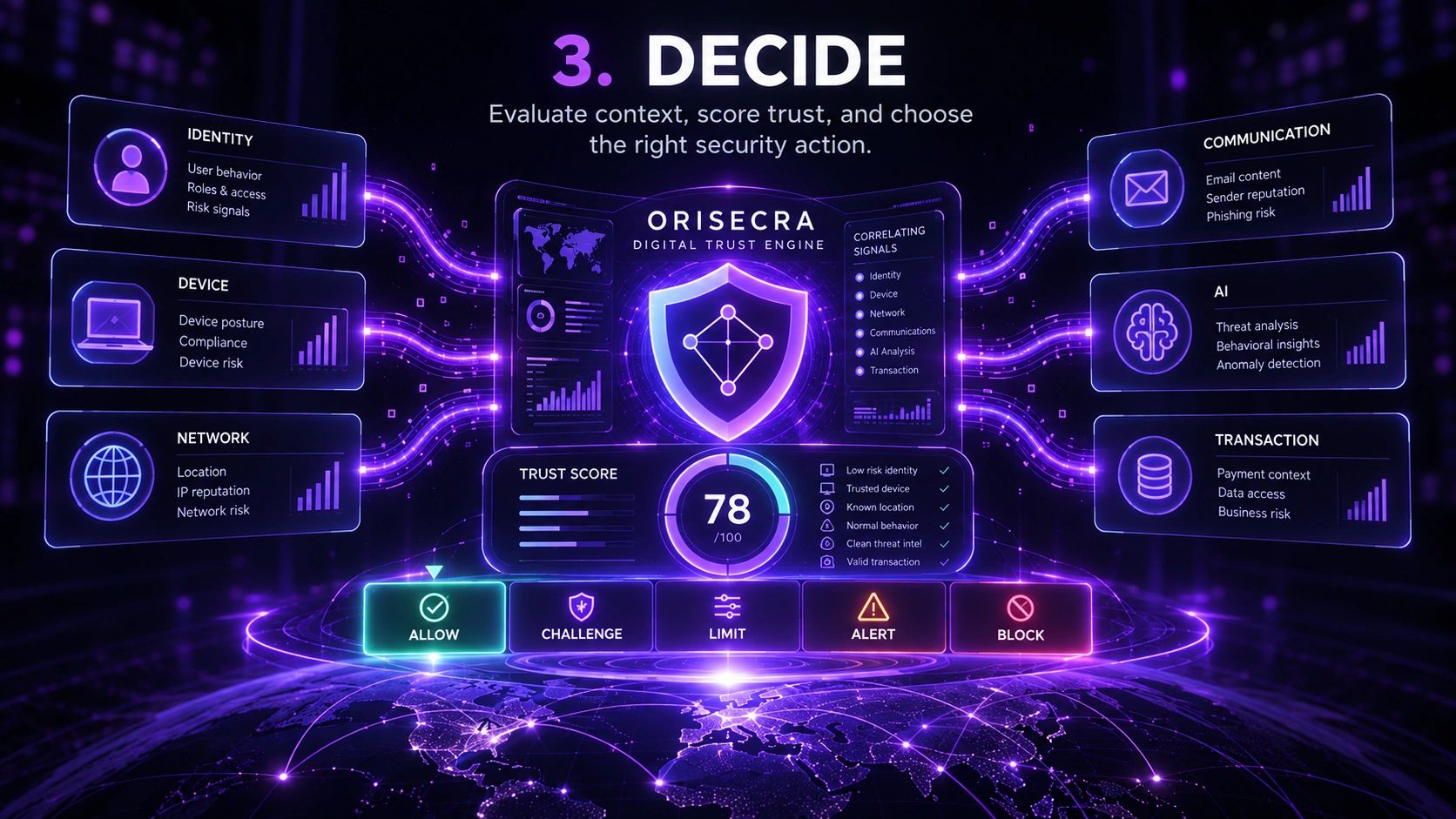
The Digital Trust Engine evaluates multiple categories of security information using specialized Orisecra Guardians.
Identity Guardian
Evaluates identity-related signals including authentication, account activity, credentials, behavioral context, and suspicious access patterns.
Device Guardian
Evaluates device health, posture, endpoint telemetry, suspicious processes, configuration, and security status.
Network Guardian
Evaluates network location, connections, unusual traffic, device discovery, threat indicators, and network behavior.
Communication Guardian
Evaluates communication-related risk including supported email and collaboration signals.
AI Guardian
Provides a framework for evaluating AI-related actions, model interactions, and future AI-agent activity within protected environments.
Transaction Guardian
Provides risk evaluation for supported financial, business, or high-value digital transactions

Trust Score and Security Decisions
Security Decisions Based on Context
Where sufficient telemetry is available, the Trust Engine produces a dynamic Orisecra Trust Score.
The score helps Orisecra determine an appropriate response.
Possible trust decisions include:
ALLOW
Activity appears trusted and can proceed normally.
CHALLENGE
Additional verification may be appropriate before allowing the activity to continue.
LIMIT
Trust has been reduced. Permissions or access may be restricted until additional verification or security evidence becomes available.
ALERT
Risk is elevated and requires attention or investigation.
BLOCK
High-risk activity may be denied or contained according to configured security policies.
Not every security source is always applicable. Orisecra distinguishes between measured evidence, unavailable telemetry, and information that is not relevant to the current event.
That distinction helps create more explainable security decisions.